○ Circle: Painting
Working on an exhibition with a beloved friend, I will present paintings, a lecture performance, and a live drawing AI instrument.
titre
La lumière ne se plie pas pour nous.
+
description
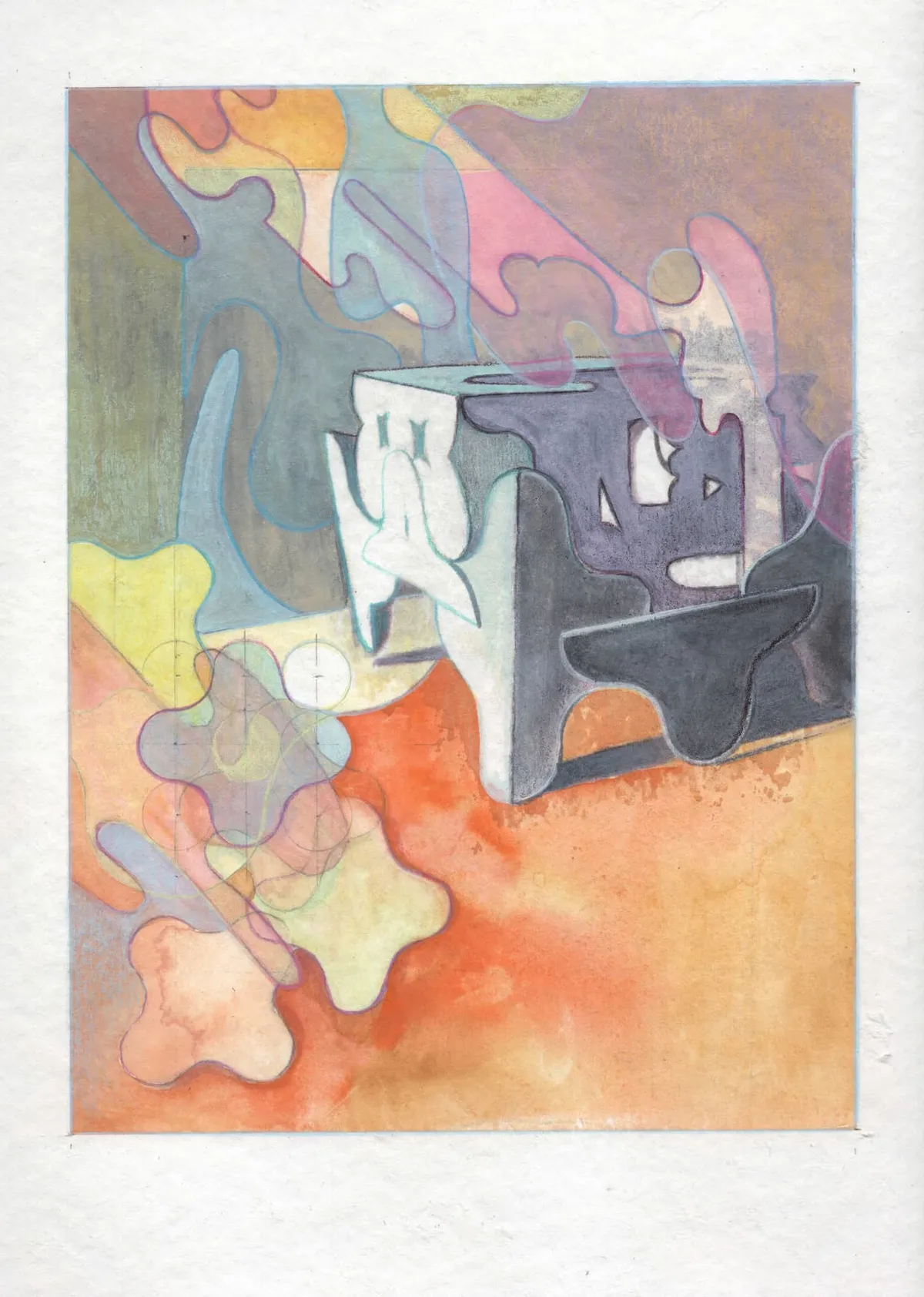
Les peintures de Marlo Duchêne partent d'une forme géométrique simple, construite à partir de neuf cercles tangents. Cette même forme traverse une série d'opérations : plier, projeter, superposer. Elle change d'échelle, passe de deux à trois dimensions, de l'immobilité au mouvement. La peinture ralentit ces opérations pour regarder ce qui se passe avant que forme, matière et regard ne se fixent. Sept semaines après sa chirurgie, il réapprend à utiliser ses bras pour peindre. De l'aquarelle à l'acrylique, avec ses propres pigments. Il bricole un dispositif de diffraction, puis un instrument de dessin en direct avec une intelligence artificielle. Son geste entre dans la machine. Et tout son corps avec.
ingrédients
- peinture, acrylique, aquarelle, diffraction, 3D
- performance-conférence, instrument de dessin IA en direct
Peinture
+
Traveling Through Dimensions: Painting
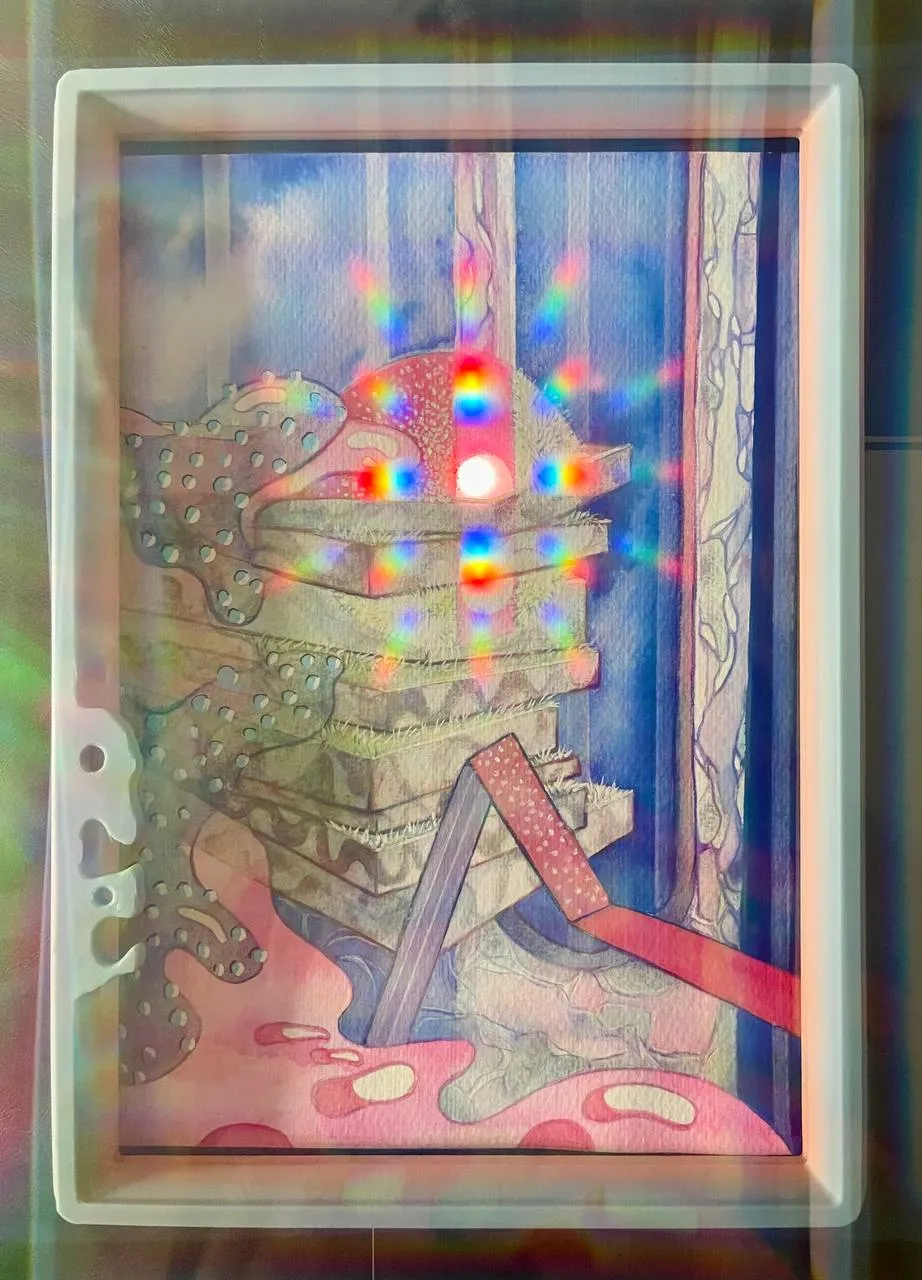
Diffraction
Quick test with diffraction sheet and 3D printed frame
One painting in my upcoming show will stage a 3D printed frame that bends light. I found a way to build a rainbow effect with a diffraction sheet and a light source behind the painting. I don't know if this just becomes its own satisfying light gadget category. There's something kitsch about it. Same as AI slop.
+
Performance
Marlo Duchêne installe une table, un compas, un ordinateur. Il s'y allonge. Sept semaines après sa chirurgie, il réapprend à utiliser ses bras pour peindre. Trente minutes de méthode : opérations, anecdotes, techniques, pigments nommés à voix haute. Une forme se recombine, à rythme accéléré, dans un instrument de dessin qu'il a bricolé avec une IA. Son geste entre dans la machine. Et tout son corps avec.
Structure satirique en quatre parties inspirée par le premier chapitre Information Overload: Research-Based Art dans le bouquin Disordered Attention, How We Look at Art and Performance Today de Claire Bishop.
The spectator is no longer expected to formulate their own arguments (as in phase one), or to question the artist’s narrative (as in phase two), or to second-guess the artist’s connections (as in phase three), but to follow the forensic method to its logical, parcelled conclusion. p.68
- “Research Rhizomes”: matériaux sur étagères/tables, spectateur en “fellow researcher.”
- “Digital to Analogue Conversion”: retour au “dead tech”
- “Search as Research”: logique numérique, “aggregation", Joselit.
- “a possible fourth phase”: Forensic Architecture.
Opération de diffraction de lumière en résonance avec le concept de méthodo diffractive, Barad, Haraway. Amba Sayal-Bennett, ‘Diffractive Analysis: Embodied Encounters in Contemporary Artistic Video Practice’, in Tate Papers no.29, 2018.
+
Diffractive Analysis
Disordered Attention
Living-Dead Drawing: Genealogy
Cadaver: Material
bio
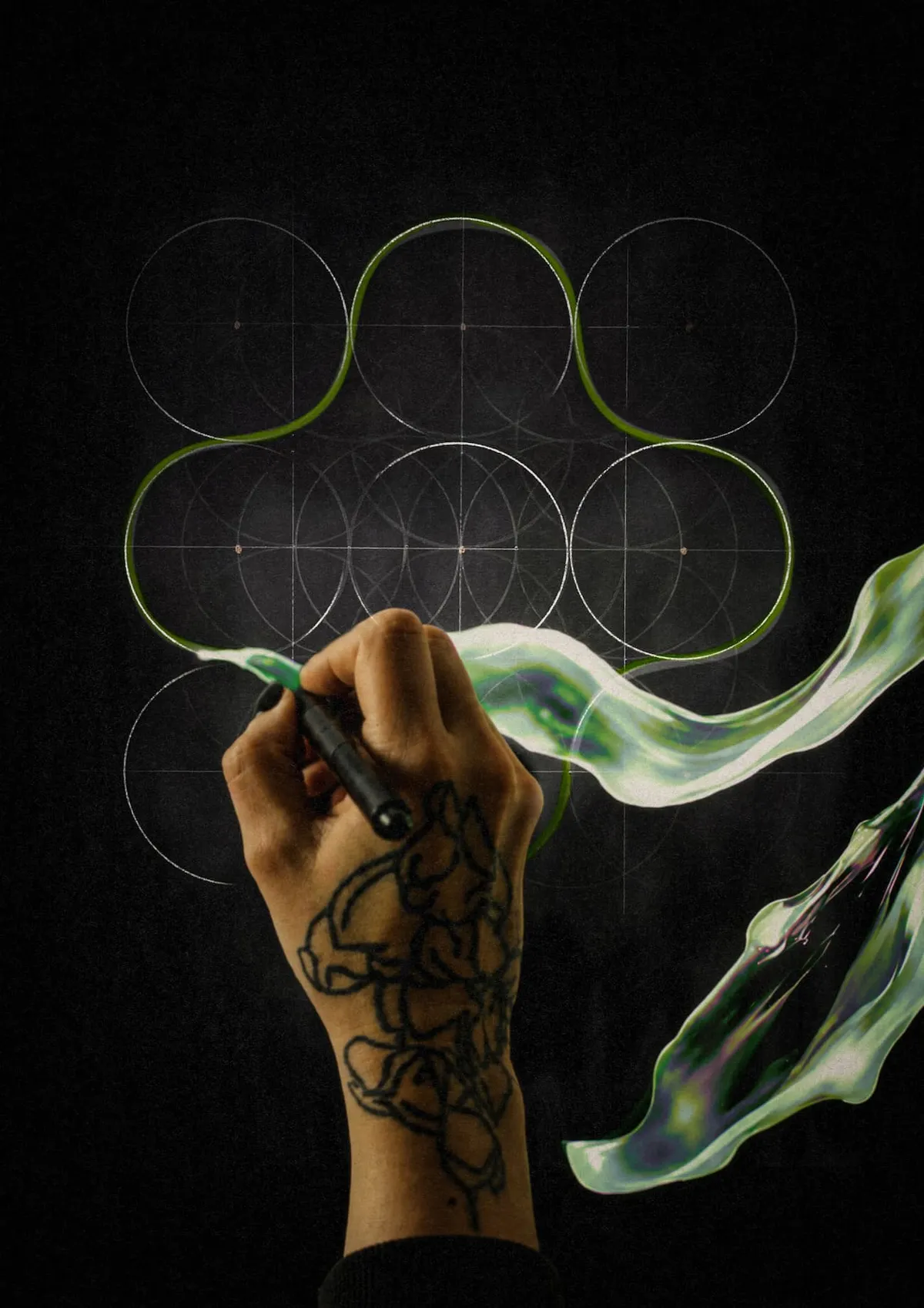
Marlo Duchêne est un artiste et chercheur franco-suisse basé à Berlin. Il ne sait pas rester en dehors de ce qu'il transforme : peinture, performance, outils computationnels. Formé aux effets visuels et à l'animation 3D, il est diplômé des masters Solo/Dance/Authorship (HZT Berlin) et Critical Curatorial Cybermedia (HEAD Genève). Il collabore avec des chorégraphes et des équipes de recherche, dans des espaces indépendants et au Max Planck Institute for Mathematics in the Sciences. Avec Suuperpose, projet collaboratif, des machines et des corps se croisent au risque de se planter ensemble, pour le plaisir. Il enseigne des méthodologies créatives aux scientifiques et des processus techniques aux artistes.
Last update: 2026.08.16